Wednesday, June 26, 2013

Melissa Meyer and Femmage


Meyer, Regale, 2005, oil on canvas, 65” x 80 “, melissameyerstudio.com

“When I’m painting, I work intuitively, physically, thinking about brushwork as a kind of choreography, a dance that happens in the wrists and arms, as well as the whole body.”[1]
--Melissa Meyer


With the gestural verve of Willem de Kooning, Helen Frankenthaler’s thin watercolor wash, and a fearless relationship with color, New York artist Melissa Meyer has often been billed as a “third-generation abstract expressionist.”[2]  Her graphic and painterly work exudes feeling, lightness, and a sense of harmonious movement.     
Meyer, Untitled, 1974, acrylic on canvas, 26” x 58 ”, melissameyerstudio.com

There is no understanding the work of Meyer without an understanding of the term “femmage”.  The term was coined by Meyer and feminist artist Miriam Schapiro in their co-authored essay Waste Not Want Not: An Inquiry into What Women Saved and Assembled – FEMMAGE[3].  The word refers to the historical use of collage techniques by women that harkens back to scrapbooks of the mid-20th century, patterned quilts of the 19th century and beyond.  According to Meyer and Schapiro, the act of creating compositions from fabric and paper scraps is an art form that women have embraced for centuries, in contrast to ideas that Picasso and Braque were the first to spearhead the use of collage as a formidable aesthetic technique[4].  Melissa Meyer’s work is imbued with these concepts of patchwork harmony.  Her thick swaths of bright watercolor in glyphic shapes create a color blocking effect, overlapping and bleeding together to attain rhythm and unity.  Directly addressing these feminist associations, Meyer comments, “All great artists were in touch with their masculine and feminine sides.  The best art has both.”[5] 


Detail of Midnight: The Hours of the Rat; Mother and Sleepy Child, Edo period (1615 – 1868), ca. 1790, Kitagawa Utamaro, polychrome woodblock print, 14 3/8 x 9 5/8“, Metropolitan Museum of Art
Meyer, Hartman 38, 2008, watercolor monotype, Riverhouse Editions, 27 ½ x 25”, melissameyerstudio.com
     There is joy and musicality in Meyer’s work that is immediately recognizable.  The strokes of her brush bounce and weave in bright colors whether in watercolor or oil.  Meyer muses on mediums, commenting, “Watercolor is usually connected with intimate, small-scale work… One of the pleasures of oil painting is… to make watercolor effects into something major, assertive, flamboyant.”[6]  She attests to being inspired by jazz musicians, as well as Japanese Ukiyo-e woodblock prints[7]; both of which speak to the lively fluidity of her application.  Meyer’s works have to ability to capture the spirit of these Edo period scenes in non-representational form by effortlessly balancing her use of the dark and the light without weighing down her compositions. 

Melissa Meyer, Pannonica, 1987, oil on canvas, 70” x 68”, GW Permanent Collection, Gift of Robert and Lucy Reitzfeld
Though Meyer professes her preference for watercolor, she wields oil paint with an equally emotive and vibrant quality.  She uses thinned paint to smoothly apply pooling and sometimes dripping layers of color values.  This allows the fluid texture of the paint to lead her motions in swirling amorphous shapes.  Though her earlier oil works, such as her piece Pannonica, from the GW Permanent Collection, are much darker in spirit, they contain the same liveliness and motion of her later works.  The title Pannonica references British-born jazz music patron Baroness Pannonica de Koenigswarter who was known as the “bebop baroness” for her commitment to the New York jazz scene during the 1950’s[8].  These eclectic sources from which Meyers draws her inspiration speak to the visual vibrancy in the language of her paintings.
After attending New York University, Melissa Meyer has enjoyed a lengthy and successful career.   She has had solo exhibitions in New York, Columbus, Ohio, and Zurich, Switzerland as well as shown in many group exhibitions including at The Jewish Museum, New York; Texas Gallery, Houston and the National Academy of Design in New York, an organization of which she is a member.  Her work is included in the collections of the Metropolitan Museum of Art, the Museum of Modern Art, the Brooklyn Museum, the Guggenheim, the Jewish Museum, and many others.  She has worked on various public projects including massive murals for the lobby of the Shiodome City Center in Tokyo Japan and others in New York.[9]  At age 66, Meyer is currently represented by Lennon Weinberg Gallery and lives and works in New York City.  She is a frequent artist in residence at Yaddo in Saratoga Springs, New York as well as at the Vermont Studio Center.[10]


[1] Melissa Meyer, “Some Notes and Thoughts on the Shiodome Project,” (January 2003), Melissa Meyer Studio, accessed March 7, 2013, http://www.melissameyerstudio.com/documents/Shiodome.pdf.
[2] Lance Esplund, “The Lighthearted Abstract Expressionist”, The Wall Street Journal, February 21, 2009, accessed March 7, 2013, http://online.wsj.com/article/SB123517123131836781.html.
[3] Miriam Schapiro and Melissa Meyer, “Waste Not Want Not: An Inquiry into What Women Saved and Assembled – FEMMAGE,” Heresies I, no. 4 (Winter 1977-78): 66-69.
[4] Schapire and Meyer, “Waste Not Want Not.”
[5] Melissa Meyer, interviewed by M.G. Lord, “Interview with Melissa Meyer,” In the Margins: 19 Interviews, (Minneapolis, MN: Montgomery Glasoe Fine Art, 1995-96), 34-36.
[6] Melissa Meyer, “Some Notes and Thoughts.”
[7] Ibid.
[8] Barry Singer, “The Baroness of Jazz”, The New York Times, October 17, 2008, accessed March 22, 2013, http://www.nytimes.com/2008/10/19/arts/music/19sing.html?ref=arts&_r=0
[9] “Bio,” Melissa Meyer Studio, accessed March 7, 2013, http://www.melissameyerstudio.com/press1.html.
[10] “Bio,” Melissa Meyer Studio.

Tuesday, June 4, 2013

Frank Wright, Painting the Civil War


Gen'l Lee Over Yonder, 1994, oil on canvas, 8" x 10"
Our exhibition After Melville and Whitman, April 9 - July 5, 2013, MPA 2nd floor cases is on view in collaboration with the GW English Department and their hosting of the Ninth International Melville Conference, June 4-7, 2013.  The exhibit gives a contemporary view of how Herman Melville and Walt Whitman have influenced American Art.  Did you know one of GW's Fine Arts Professors is also a Civil War expert?

Frank Wright prefers to express rather than reflect. This may seem quite odd, due to the fact that most of his paintings are historical representations of DC. How exactly can one express the past without reflecting? Wright does this by masterfully blending facets of his life with historical reconstructions of Washington resulting in painstakingly detailed works of art.

This DC native, whose family has been in the area for six generations, paints images of Washington ranging from the old Analostan Island (now Roosevelt) to the original Willard Hotel and Pennsylvania Avenue. It is hard not to notice the incredible amount of detail in every brushstroke, but what one may not notice is just how Wright personalizes his paintings. He explains that you can find many a face of his friends, students, or literary figures (such as Walt Whitman) amongst the various crowds he paints. Such details add a particular touch to the impersonality of history. One thing is certain – Wright is incredibly talented.

He attended American University where he then won the Paul J. Sachs Fellowship in Graphic Arts. This led him to Paris, where he studied prints and woodcuts in depth at Atelier 17.  Gallery Assistant Hannah Spector, recently sat down with Professor Wright to discuss his work, the history of Washington, DC, and where the two intersect:


Hannah Spector: Do you mainly get inspiration for your historical paintings from photographs?

Frank Wright: Well, not exactly. There's no photograph of most of these, I made them up. Mainly
pictures of Civil War reenactments and I saw a guy there that looked like Robert E. Lee, so I turned him, into Robert E. Lee.

HS: I like how you do the perspective of old DC. Have you gotten that mainly from piecing together different sources?

FW: I have a large collection of old photographs of old Washington and my family has also been here for six generations. My grandfather and my family on my mother's side have also been here for six generations. The first one who came here was Washington S. Wright and he came here in 1826 from Alexandria, from old town Alexandria. His father was a hatter and his father before him was as well. They were on Navy Yard Hill, where of course the river traffic was very important in those days. He had a business there during and before the Civil War.

Frank Wright, The Grand Review, 1990-91, oil on canvas, 48" x 96".
HS: Is that why you have such an interest in DC's history?

FW: Well yeah, but I have a general interest in it. Of course being in an early office building just one block from Ford's Theater always meant I had a great interest in that area and I was there for 26 years, across from the Portrait Gallery.

HS: That's a pretty area.

FW: It is now, but it's been through its ups-and-downs.

HS: What's your favorite painting you've done?

FW: This is my favorite image, The Grand Review, 1990-91.  It took place on Pennsylvania Avenue on May 25, 1865 shortly after the President [Abraham Lincoln] was killed and it's based on a reenactment I saw in the early 90's.  The whole cast of Glory, the movie, marched in that parade.  So I ran in front of the parade all the way from 7th street to 14th street to get this image.  It took me well over a year to do.

detail from The Grand Review
HS: Is that Walt Whitman there?

FW: Yes, Walt Whitman.

HS: The detail is incredible, how do you have the patience for this?

FW: Time, time. Well, you know when you do a major project like this it's like doing embroidery where you think it will take its time and it will be finished when it's finished. But yes, this is Walt Whitman and this other man is his friend Pete Doyle and at the time of this parade they didn't know each other, but I decided to put Pete Doyle in it. He was the closest friend Walt Whitman had, very close relationship. These here are the contrabands. You know Washington after the war, they freed the contrabands. They were people owned by other people and they kept them on Mason's Island, which is now Roosevelt's Island. During the war they stayed there.

HS: Where's the Willard in this panting?

FW: Here. It's where Julia Ward Howe wrote the Battle Hymn of the Republic. Now, sometime after this, the present Willard was built around 1900. This is the former building that was there. When I was a child, it was quite a wonderful place filled with World War II activities. People would go down there, and it was "smokeville", everybody smoked and you could hardly see yourself through the smoke. Later on, the Willard went into disarray for a number of years it just sat there without being occupied. Then an enterprising group of businessmen brought it back.

HS: So are your paintings interspersed around different parts of DC?

FW: Yes, and Vienna. But this [The Grand Review] was one of the most ambitious paintings I ever did. Some of my friends were in the reenactment here, so they're in here. I have several of my students and friends in here. And everything is absolutely accurate because I was able to get access at the Library of Congress to pictures that were not generally known. Everybody knows the [Matthew] Brady ones, but they weren't as interesting as the ones I found that showed the streets and the stores. So, all of this is very accurate. Of course there was a welcome home sign in the parade from Washington school children. This is the second day of the parade. The first day was May the 23rd when Meade's army marched down. The second day was Sherman's army, they walked up from South Carolina... Sherman's army had suffered a great deal, but they were excellent in the parade. They marched very well and I have books about the parade.


HS: It's crazy how much history is behind each painting.

FW: I've done some paintings of the encampments along the Potomac.  This one, Watchfires in the Evening Dews and Damps, 1993, was at the Battle of Nashville, Tennessee.  It was a crucial battle in 1864 because Hood's army could never reorganize after that Battle.  It's a compilation of photographs and my imagination. 

HS: Did you ever go to art school or did you just study in Paris?

FW: I went to art school.  I went to American University, which had a great art department.  I also taught at the Corcoran for 4 years.

HS: They just partnered with Maryland.

FW: Yes.  Originally the Corocan School was the art department at The George Washington University.  When I was teaching there, there were GW students in the department.  We had a small department, just about 2 or 3 students at GW.  Then they sent all of them to the Corcoran, especially for painting, sculpture, and ceramics.  When I came in 1970, they lifted me from the Corcoran.  While I was there, they started to soar. 

HS: Do you teach painting?

FW: I am a painter, but I've always taught drawing.  Mainly because there was an opening and I took that person's place.  One of my best friends came a year earlier and taught painting, but we had our studio together, a man named [William] Woodward.  They whole time I was at the Corcoran, he was teaching painting and I was teaching drawing.  Then we both moved to GW and he taught for 32 years and I've been teaching drawing for 42 years.

HS: Can you tell me about your time in Paris?

FW: Well, I had a fellowship to Paris.  It was given to me by the founder of the printed collection of the National Gallery, named Lessing Rosenwald.  He wanted to establish a fellowship in honor of his best friend who got him started as a collector, who was Paul J. Sachs.  I was the first Paul J. Sachs fellow at the National Gallery and from there I went to Harvard and from there I went to Paris.  I didn't realize 'til much later that Paul's mother was Goldman and his father was Sachs.  So, I went to Paris at that time.

HS: Your prints are amazing.  What type are they?
A Man and His Dog, 1970, engraving, 6-3/8" x 4-3/8"

FW: They are engravings and etchings.  There's one around the corner called An Old Man and His Dog.  This fellow was a vagrant who used to go through the trashcans in front of the National Portrait Gallery.  He was an interesting looking character and I though I might be taking a chance but I invited him up to pose.  He lived in one of the boarding houses around, but he wasn't a derelict.  He was sort of an old man that used to ride the railroad.  He was from New Orleans, but I found him very interesting and bright and intelligent.


***
It is evident that Wright knows an incredible amount of Washington history. By injecting history into his paintings, he is able to create pieces which are more than just an image – they are a story, an account, and a depiction of moments in time. His experience and natural ease with the brush make his works important for both the George Washington University, and Washington itself. A number of paintings by Frank Wright are currently on view on the 3rd floor of Gelman Library. For more of Wright's work, go to his website: http://www.gwu.edu/~fwright.

Wednesday, April 3, 2013

A Conversation With Sculptor Robert Sanabria


Continuum: defined as a part of a whole which cannot be distinguished from neighboring parts except by arbitrary division. Artist Robert Sanabria evoked this meaningful word to name his sculpture, which is housed in the GW Permanent Collection, administered by The Luther Brady Art Gallery. As one looks at the sinuous lines of brazed metal in the sculpture—you can truly see no end and no beginning to the material.
         Sanabria is a retired army lieutenant colonel. Aside from dabbling in writing (he has two published books), he sculpts. He works primarily with metal—using the difficult copper brazing technique. This technique makes strong joints with the metal. In our correspondence with the artist, he further explains his work and inspiration.

Robert Sanabria, Continuum, bronze on copper, 18" x 16" x 20"

Gallery Assistant Hannah Spector: In our permanent collection, we have your sculpture, Continuum. Can you describe where the inspiration for this piece came from?
Robert Sanabria: My sculpture, Continuum, was the direct result of a visit to the studio of the late Italian-American sculptor, Harry Bertoia (famous for his Diamond Chair). I first became aware of Harry while stationed in Germany during the late 50s and early 60s. Stationed in the Washington DC area a few years later, I discovered that Harry had a sculpture exhibition at Knoll International in Georgetown. Harry was present the day I visited his show. When asked about the possibility of visiting his studio, he suggested I write to set up a date. It was during that subsequent meeting that I first saw his sculpture fabricated in brazed copper tubing, a technique he pioneered.

HS: How were your first attempts with brazing?
RS: My first brazed copper pieces were disasters, due to my inability to join, i.e. braze, the copper tubing without burning holes in it. Eventually I developed the proper touch and proceeded to create larger pieces. Today, I mainly respond to commissions from private, commercial and municipal clients employing Harry’s brazed copper technique. The most recent installation was of a piece entitled, Viento, or wind at the new Four Seasons Hotel in Chicago.

Robert Sanabria, Viento, bronze on copper, 48" x 36" x 45"

HS: When did you decide to pursue a career in art? Do you have any formal training?
RS: I had loved and done art since childhood. Retiring from the Army in the early 70s, I decided to pursue a career as an artist and enrolled first at the Corcoran and eventually received an MFA from the University of Maryland in the late 70s. Throughout that period, in search of a medium to focus on, I tried everything from wood and stone carving to figure modeling to pieces welded and brazed.
  
HS:  How do you split your time between sculpting and writing? Do you have any more books in the works?
RS:  Unless I’m working on a commission with a deadline, I usually write during the morning and work in the studio in the afternoon. At the moment, I’m re-writing a screenplay based on my novel. When that’s finished, if such an undertaking ever is, I will return to writing. A number of people who’ve read the novel have suggested a sequel. I’ve started an attempt to discover whether it’s worth continuing. If not, I’ll abandon it and start anew in a different direction.

HS: It seems as though a lot of your inspiration came from your time in the military (your experiences, etc.). Can you explain that life-changing job as a source of inspiration and also where else do you seek inspiration? 
RS: Apart from the discipline and organizing ability that I assimilated from my military career, it doesn’t inspire my art. Inspiration often comes from simply working with the medium, whatever that happens to be. As a consequence, I often start out with one idea only to have that overtaken by a different idea inspired while working on the first, an event I always welcome. Being involved in a competition can also inspire a concept. In his book, My Life in Sculpture, the late Jacques Lipchitz described the manner in which he “discovers” a concept by making a series of clay miniatures. After the first one, he takes the part of it that appeals to him and tries to incorporate that into the next one. After ten or so of these, he settles on one and works on that to a completion. But even then, after coming back to it a day or so, he invariably makes more changes to improve it. I use the same approach, but usually not in clay. Instead, I often use Styrofoam, which I carve or assemble in pieces, or make small metal models as a point of departure.

HS:  What do you find most rewarding about the sculpture making process, or what is your favorite part?
RS: A large-scale sculpture usually starts out as a maquette, or scale model. It is then handed off to a fabricator or foundry, where it is scaled up to the desired size and finished. In that event, the sculptor’s hand is mostly eliminated, except to sign the piece. I’ve tried to do sculpture that allows me to do most if not all of the work myself. Of course when it isn’t possible to everything myself, I, too, resort to the necessary assistance. In the video, “Private Dreams, Public Art,” on my web site is a good example. The maquette can be seen in the background as I work on the enlargement. The concrete casting is done at a concrete yard, under my watchful eye.
           My favorite part is developing a concept and bringing it to realization and done mostly with my own hands.

       Sanabria’s work is currently on display at the Cosmos Club in Washington, D.C. His wife, Sherry Sanabria, has work on display there as well.

Private Dreams, Public Art, Robert Sanabria

Wednesday, February 13, 2013

The Steeplechase


Edgar Degas, Scene from the Steeplechase--The Fallen Jockey (1866)

The horse seems a perfect subject for the artist—it exhibits both beauty in movement and unpredictability in the power of nature. Edgar Degas was one artist who looked towards these beasts for artistic inspiration. During the 1860s, horse racing, particularly the steeplechase, was considered a popular pastime of the French well-to-do. The steeplechase originated in the English and Irish countryside, where the opponents would race towards a fixed point in the distance, typically a church steeple (hence the name). This early form of the steeplechase proved dangerous, sending riders to harsh landings, and occasionally—death. The first steeplechase is said to have taken place in County Cork, Ireland in 1752. Two daring men, Cornelius O’Callaghan and Edmund Blake, raced 4 ½ miles towards a distant church.[1] The accounts of this race solidified and popularized races of this nature. The French took this informal style of racing and gentrified it—creating an aristocratic pastime with rules and regulations.
Degas’ Scene from the Steeplechase—the Fallen Jockey (1866), was one of Degas’ largest paintings—measuring almost 7 by 5 feet (and currently on display at the National Gallery of Art). There is a stark disparity between the serene backdrop of man interacting with nature and the aggressive activities of the steeplechase. If one looks at the jockey, his delicate face portrays a sense of calm—even while he lies below the horse’s hooves and is subject to imminent danger. The jockey is said to have been based on Degas’ younger brother, Achille.[2] Perhaps that is why there is such a strong element of portraiture. Many sketches remain of Degas’ in depth study of this portion of the work. In this painting, Degas exhibits a noticeable amount of pentimento, or a reworking, where shadows remain of the original positions of both the horse’s tail and its inner-front leg. Stylistically, Degas juxtaposes the softness of the jockey’s face with the bold outlines of the horses. These outlines were seen in many of his final works, dating from the 1890s to the early 1900s.[3] The richness of the black brushstrokes symbolizes free-movement and at the same time—discipline. They sought to constrain and emphasize movement captured at a given moment.
  Clarice Smith, Leaving the Gate (2011)
A strong parallel can be seen between Degas’ equestrian pieces and works by the contemporary artist Clarice Smith, which are now on view in the Luther W. Brady Art Gallery. Smith’s Leaving the Gate (2011) and Steeplechase (2012) also make use of bold outlines to create movement in the dark figures of the horses. While her works emphasize form more than movement, Leaving the Gate shows a contrast of color that stresses the lively action from the serene setting. She makes use of lush oranges and dimensional black to frame her narrative. Aside from the obvious relation in subject matter, Smith brings a uniquely stylized view of this pastime. It is as though she captured a single moment in intense movement—showing grace in tension.    

[1]Degas: At the Races. Washington: National Gallery of Art, n.d. Print.
[2]"History of Steeplechase." Iroquois Steeplechase. N.p., 2013. Web. 06 Feb. 2013.
[3]Schenkel, Ruth. "Heilbrunn Timeline of Art History." Edgar Degas: Painting and Drawing. Metropolitan Museum of Art, n.d. Web. 06 Feb. 2013.

Friday, February 8, 2013

Larry Fink : Scenes of American Character


“The photograph is an attempt to give the perception of the moment some relationship to immortality.” [1]
-- Larry Fink


Pat Sabatine’s Eighth Birthday Party, PA, 1977, 
cover photograph of Social Graces
When it comes to defining the American experience, photography is often the medium of choice, from the striking Great Depression imagery of Dorthea Lange to the graphic contemporary portraits of Annie Leibovitz.  One such photographer that excels at capturing the American spirit is Larry Fink.  Fink portrays the American lifestyle with a balanced mixture of bitter social commentary and intimate sentimentality.  In his first publication Social Graces, 1984, Fink nostalgically compares the celebrations of varying social classes[2], whereas the artist reveals poignant poverty in America in his 2003 series “Diminishing Returns”, originally published in Vanity Fair and later exhibited at Princeton University[3].  Fink’s oeuvre encompasses a large range of themes and evokes every imaginable emotion. 


Kate Moss, NYC, 1999
Fink was born in Brooklyn, New York in 1941 and began his career as a professional photographer in the 1970s, photographing events of the upper classes, such as museum galas and art openings.  He has gone on to show work regularly in galleries in New York, L.A., and Paris as well as one man shows at the Museum of Modern Art, the Whitney Museum of American Art, and many more both in America and abroad.  He worked as a photographer for Vanity Fair, chronicling celebrity and high society nightlife.  He has also published multiple books, most recently a retrospective collection of works titled Attraction and Desire: 50 Years in Photography[4]. 

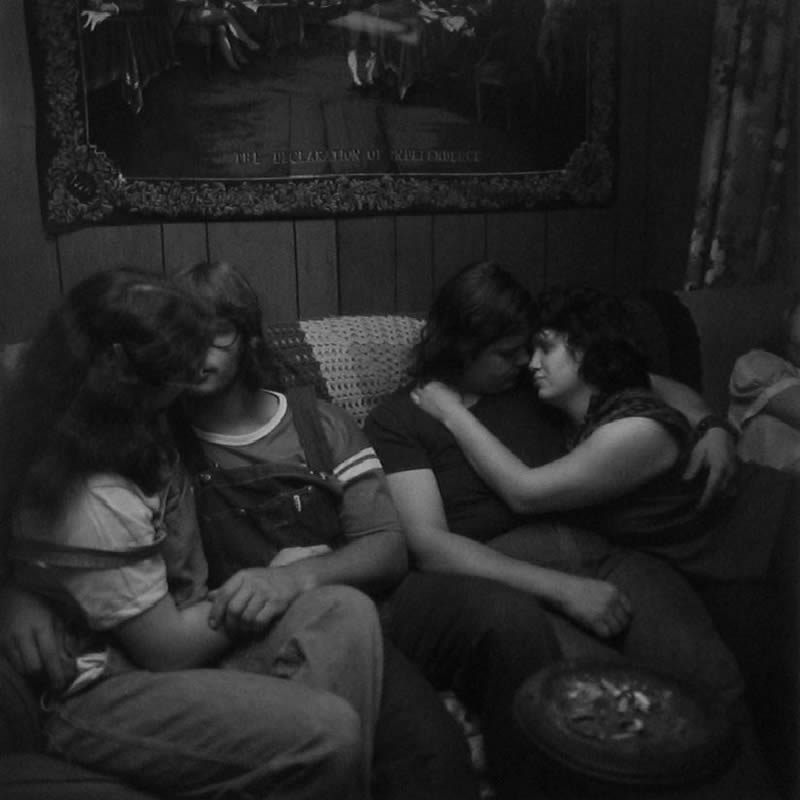
Fink often opts for closely cropped, confrontational compositions that press closely into the psyche of his subjects.  Alternatively, he may avoid faces altogether for a voyeuristic style. Black and white is his forte, and he effortlessly manipulates light and dark to isolate subjects from a crowded room and create graphic shapes.  Though he is often recognized for his iconic, glittering imagery of Hollywood, Fink has done projects of every imaginable subject, including beatniks, boxers, working class families, and the occasional presidential candidate, including President Barack Obama and Hillary Clinton.


Declaration of Independence, Martin’s Creek PA, 1978,
 “Making Out: 1957-1980”, 
GW Permanent Collection, Gift of Adam J. Rappaport, 2010.
In a New York Times interview Fink commented on his work, “My life is profoundly physical. Photography for me is the transformation of desire" [5].   Certainly this concept presents itself in his series titled “Making Out: 1957-1980”.  In this series, Fink explores the intimate nature of human relationships by capturing personal moments between friends and lovers. In Declaration of Independence, Fink casts light only on faces and body parts, allowing the emotions of his subjects to come to the forefront in tangible form, while the background seems to recede into vague darkness.  The clever inclusion of “Declaration of Independence” banner on the wall behind the subjects’ heads highlights the serie’s themes of American passion.


Larry Fink currently works as a professor of photography at Bard College while continuing his work as an artist, and has educated students there for the past 16 years.  Whether documenting the biggest stars or the smallest basements, Fink’s work is a lively testament to the beauty of the human condition.

Visit Larry Fink’s blog at http://larryfink.blogspot.com/ for updates on his current projects!


[1] Larry Fink, interview by Adriana Teresa, “A Moment with Larry Fink”, New York Times, January 6, 2011, accessed January 25, 2013, http://lens.blogs.nytimes.com/2011/01/06/a-moment-with-larry-fink/.
[2] Larry Fink, “Publications: Intros : Social Graces,” Larry Fink Photography, accessed January 25, 2013, http://www.larryfinkphotography.com/publications_intros.html#socialgraces
[3] Jenny Boyar, “Poignant photos from controversial artist Larry Fink,” The Lafayette, March 11, 2005, accessed January 25, 2013. http://www.thelaf.com/a-e/poignant-photos-from-controversial-artist-larry-fink-1.2517150.
[4] “Biography,” Larry Fink Photography, accessed January 25, 2013, http://www.larryfinkphotography.com/bio.html.
[5] Fink, “A Moment with Larry Fink,” New York Times.

About the Blog

Ipsum Tempor

Sit amet

Covering exhibits at the Luther W. Brady Art Gallery and giving you a peek into the Permanent Collection of the George Washington University.

Ultricies Eget

Coming Soon...

Coming Soon...
Howard Hodgkin: Paintings - May 16, 2012

Wednesday, June 26, 2013

Melissa Meyer and Femmage


Meyer, Regale, 2005, oil on canvas, 65” x 80 “, melissameyerstudio.com

“When I’m painting, I work intuitively, physically, thinking about brushwork as a kind of choreography, a dance that happens in the wrists and arms, as well as the whole body.”[1]
--Melissa Meyer


With the gestural verve of Willem de Kooning, Helen Frankenthaler’s thin watercolor wash, and a fearless relationship with color, New York artist Melissa Meyer has often been billed as a “third-generation abstract expressionist.”[2]  Her graphic and painterly work exudes feeling, lightness, and a sense of harmonious movement.     
Meyer, Untitled, 1974, acrylic on canvas, 26” x 58 ”, melissameyerstudio.com

There is no understanding the work of Meyer without an understanding of the term “femmage”.  The term was coined by Meyer and feminist artist Miriam Schapiro in their co-authored essay Waste Not Want Not: An Inquiry into What Women Saved and Assembled – FEMMAGE[3].  The word refers to the historical use of collage techniques by women that harkens back to scrapbooks of the mid-20th century, patterned quilts of the 19th century and beyond.  According to Meyer and Schapiro, the act of creating compositions from fabric and paper scraps is an art form that women have embraced for centuries, in contrast to ideas that Picasso and Braque were the first to spearhead the use of collage as a formidable aesthetic technique[4].  Melissa Meyer’s work is imbued with these concepts of patchwork harmony.  Her thick swaths of bright watercolor in glyphic shapes create a color blocking effect, overlapping and bleeding together to attain rhythm and unity.  Directly addressing these feminist associations, Meyer comments, “All great artists were in touch with their masculine and feminine sides.  The best art has both.”[5] 


Detail of Midnight: The Hours of the Rat; Mother and Sleepy Child, Edo period (1615 – 1868), ca. 1790, Kitagawa Utamaro, polychrome woodblock print, 14 3/8 x 9 5/8“, Metropolitan Museum of Art
Meyer, Hartman 38, 2008, watercolor monotype, Riverhouse Editions, 27 ½ x 25”, melissameyerstudio.com
     There is joy and musicality in Meyer’s work that is immediately recognizable.  The strokes of her brush bounce and weave in bright colors whether in watercolor or oil.  Meyer muses on mediums, commenting, “Watercolor is usually connected with intimate, small-scale work… One of the pleasures of oil painting is… to make watercolor effects into something major, assertive, flamboyant.”[6]  She attests to being inspired by jazz musicians, as well as Japanese Ukiyo-e woodblock prints[7]; both of which speak to the lively fluidity of her application.  Meyer’s works have to ability to capture the spirit of these Edo period scenes in non-representational form by effortlessly balancing her use of the dark and the light without weighing down her compositions. 

Melissa Meyer, Pannonica, 1987, oil on canvas, 70” x 68”, GW Permanent Collection, Gift of Robert and Lucy Reitzfeld
Though Meyer professes her preference for watercolor, she wields oil paint with an equally emotive and vibrant quality.  She uses thinned paint to smoothly apply pooling and sometimes dripping layers of color values.  This allows the fluid texture of the paint to lead her motions in swirling amorphous shapes.  Though her earlier oil works, such as her piece Pannonica, from the GW Permanent Collection, are much darker in spirit, they contain the same liveliness and motion of her later works.  The title Pannonica references British-born jazz music patron Baroness Pannonica de Koenigswarter who was known as the “bebop baroness” for her commitment to the New York jazz scene during the 1950’s[8].  These eclectic sources from which Meyers draws her inspiration speak to the visual vibrancy in the language of her paintings.
After attending New York University, Melissa Meyer has enjoyed a lengthy and successful career.   She has had solo exhibitions in New York, Columbus, Ohio, and Zurich, Switzerland as well as shown in many group exhibitions including at The Jewish Museum, New York; Texas Gallery, Houston and the National Academy of Design in New York, an organization of which she is a member.  Her work is included in the collections of the Metropolitan Museum of Art, the Museum of Modern Art, the Brooklyn Museum, the Guggenheim, the Jewish Museum, and many others.  She has worked on various public projects including massive murals for the lobby of the Shiodome City Center in Tokyo Japan and others in New York.[9]  At age 66, Meyer is currently represented by Lennon Weinberg Gallery and lives and works in New York City.  She is a frequent artist in residence at Yaddo in Saratoga Springs, New York as well as at the Vermont Studio Center.[10]


[1] Melissa Meyer, “Some Notes and Thoughts on the Shiodome Project,” (January 2003), Melissa Meyer Studio, accessed March 7, 2013, http://www.melissameyerstudio.com/documents/Shiodome.pdf.
[2] Lance Esplund, “The Lighthearted Abstract Expressionist”, The Wall Street Journal, February 21, 2009, accessed March 7, 2013, http://online.wsj.com/article/SB123517123131836781.html.
[3] Miriam Schapiro and Melissa Meyer, “Waste Not Want Not: An Inquiry into What Women Saved and Assembled – FEMMAGE,” Heresies I, no. 4 (Winter 1977-78): 66-69.
[4] Schapire and Meyer, “Waste Not Want Not.”
[5] Melissa Meyer, interviewed by M.G. Lord, “Interview with Melissa Meyer,” In the Margins: 19 Interviews, (Minneapolis, MN: Montgomery Glasoe Fine Art, 1995-96), 34-36.
[6] Melissa Meyer, “Some Notes and Thoughts.”
[7] Ibid.
[8] Barry Singer, “The Baroness of Jazz”, The New York Times, October 17, 2008, accessed March 22, 2013, http://www.nytimes.com/2008/10/19/arts/music/19sing.html?ref=arts&_r=0
[9] “Bio,” Melissa Meyer Studio, accessed March 7, 2013, http://www.melissameyerstudio.com/press1.html.
[10] “Bio,” Melissa Meyer Studio.

Tuesday, June 4, 2013

Frank Wright, Painting the Civil War


Gen'l Lee Over Yonder, 1994, oil on canvas, 8" x 10"
Our exhibition After Melville and Whitman, April 9 - July 5, 2013, MPA 2nd floor cases is on view in collaboration with the GW English Department and their hosting of the Ninth International Melville Conference, June 4-7, 2013.  The exhibit gives a contemporary view of how Herman Melville and Walt Whitman have influenced American Art.  Did you know one of GW's Fine Arts Professors is also a Civil War expert?

Frank Wright prefers to express rather than reflect. This may seem quite odd, due to the fact that most of his paintings are historical representations of DC. How exactly can one express the past without reflecting? Wright does this by masterfully blending facets of his life with historical reconstructions of Washington resulting in painstakingly detailed works of art.

This DC native, whose family has been in the area for six generations, paints images of Washington ranging from the old Analostan Island (now Roosevelt) to the original Willard Hotel and Pennsylvania Avenue. It is hard not to notice the incredible amount of detail in every brushstroke, but what one may not notice is just how Wright personalizes his paintings. He explains that you can find many a face of his friends, students, or literary figures (such as Walt Whitman) amongst the various crowds he paints. Such details add a particular touch to the impersonality of history. One thing is certain – Wright is incredibly talented.

He attended American University where he then won the Paul J. Sachs Fellowship in Graphic Arts. This led him to Paris, where he studied prints and woodcuts in depth at Atelier 17.  Gallery Assistant Hannah Spector, recently sat down with Professor Wright to discuss his work, the history of Washington, DC, and where the two intersect:


Hannah Spector: Do you mainly get inspiration for your historical paintings from photographs?

Frank Wright: Well, not exactly. There's no photograph of most of these, I made them up. Mainly
pictures of Civil War reenactments and I saw a guy there that looked like Robert E. Lee, so I turned him, into Robert E. Lee.

HS: I like how you do the perspective of old DC. Have you gotten that mainly from piecing together different sources?

FW: I have a large collection of old photographs of old Washington and my family has also been here for six generations. My grandfather and my family on my mother's side have also been here for six generations. The first one who came here was Washington S. Wright and he came here in 1826 from Alexandria, from old town Alexandria. His father was a hatter and his father before him was as well. They were on Navy Yard Hill, where of course the river traffic was very important in those days. He had a business there during and before the Civil War.

Frank Wright, The Grand Review, 1990-91, oil on canvas, 48" x 96".
HS: Is that why you have such an interest in DC's history?

FW: Well yeah, but I have a general interest in it. Of course being in an early office building just one block from Ford's Theater always meant I had a great interest in that area and I was there for 26 years, across from the Portrait Gallery.

HS: That's a pretty area.

FW: It is now, but it's been through its ups-and-downs.

HS: What's your favorite painting you've done?

FW: This is my favorite image, The Grand Review, 1990-91.  It took place on Pennsylvania Avenue on May 25, 1865 shortly after the President [Abraham Lincoln] was killed and it's based on a reenactment I saw in the early 90's.  The whole cast of Glory, the movie, marched in that parade.  So I ran in front of the parade all the way from 7th street to 14th street to get this image.  It took me well over a year to do.

detail from The Grand Review
HS: Is that Walt Whitman there?

FW: Yes, Walt Whitman.

HS: The detail is incredible, how do you have the patience for this?

FW: Time, time. Well, you know when you do a major project like this it's like doing embroidery where you think it will take its time and it will be finished when it's finished. But yes, this is Walt Whitman and this other man is his friend Pete Doyle and at the time of this parade they didn't know each other, but I decided to put Pete Doyle in it. He was the closest friend Walt Whitman had, very close relationship. These here are the contrabands. You know Washington after the war, they freed the contrabands. They were people owned by other people and they kept them on Mason's Island, which is now Roosevelt's Island. During the war they stayed there.

HS: Where's the Willard in this panting?

FW: Here. It's where Julia Ward Howe wrote the Battle Hymn of the Republic. Now, sometime after this, the present Willard was built around 1900. This is the former building that was there. When I was a child, it was quite a wonderful place filled with World War II activities. People would go down there, and it was "smokeville", everybody smoked and you could hardly see yourself through the smoke. Later on, the Willard went into disarray for a number of years it just sat there without being occupied. Then an enterprising group of businessmen brought it back.

HS: So are your paintings interspersed around different parts of DC?

FW: Yes, and Vienna. But this [The Grand Review] was one of the most ambitious paintings I ever did. Some of my friends were in the reenactment here, so they're in here. I have several of my students and friends in here. And everything is absolutely accurate because I was able to get access at the Library of Congress to pictures that were not generally known. Everybody knows the [Matthew] Brady ones, but they weren't as interesting as the ones I found that showed the streets and the stores. So, all of this is very accurate. Of course there was a welcome home sign in the parade from Washington school children. This is the second day of the parade. The first day was May the 23rd when Meade's army marched down. The second day was Sherman's army, they walked up from South Carolina... Sherman's army had suffered a great deal, but they were excellent in the parade. They marched very well and I have books about the parade.


HS: It's crazy how much history is behind each painting.

FW: I've done some paintings of the encampments along the Potomac.  This one, Watchfires in the Evening Dews and Damps, 1993, was at the Battle of Nashville, Tennessee.  It was a crucial battle in 1864 because Hood's army could never reorganize after that Battle.  It's a compilation of photographs and my imagination. 

HS: Did you ever go to art school or did you just study in Paris?

FW: I went to art school.  I went to American University, which had a great art department.  I also taught at the Corcoran for 4 years.

HS: They just partnered with Maryland.

FW: Yes.  Originally the Corocan School was the art department at The George Washington University.  When I was teaching there, there were GW students in the department.  We had a small department, just about 2 or 3 students at GW.  Then they sent all of them to the Corcoran, especially for painting, sculpture, and ceramics.  When I came in 1970, they lifted me from the Corcoran.  While I was there, they started to soar. 

HS: Do you teach painting?

FW: I am a painter, but I've always taught drawing.  Mainly because there was an opening and I took that person's place.  One of my best friends came a year earlier and taught painting, but we had our studio together, a man named [William] Woodward.  They whole time I was at the Corcoran, he was teaching painting and I was teaching drawing.  Then we both moved to GW and he taught for 32 years and I've been teaching drawing for 42 years.

HS: Can you tell me about your time in Paris?

FW: Well, I had a fellowship to Paris.  It was given to me by the founder of the printed collection of the National Gallery, named Lessing Rosenwald.  He wanted to establish a fellowship in honor of his best friend who got him started as a collector, who was Paul J. Sachs.  I was the first Paul J. Sachs fellow at the National Gallery and from there I went to Harvard and from there I went to Paris.  I didn't realize 'til much later that Paul's mother was Goldman and his father was Sachs.  So, I went to Paris at that time.

HS: Your prints are amazing.  What type are they?
A Man and His Dog, 1970, engraving, 6-3/8" x 4-3/8"

FW: They are engravings and etchings.  There's one around the corner called An Old Man and His Dog.  This fellow was a vagrant who used to go through the trashcans in front of the National Portrait Gallery.  He was an interesting looking character and I though I might be taking a chance but I invited him up to pose.  He lived in one of the boarding houses around, but he wasn't a derelict.  He was sort of an old man that used to ride the railroad.  He was from New Orleans, but I found him very interesting and bright and intelligent.


***
It is evident that Wright knows an incredible amount of Washington history. By injecting history into his paintings, he is able to create pieces which are more than just an image – they are a story, an account, and a depiction of moments in time. His experience and natural ease with the brush make his works important for both the George Washington University, and Washington itself. A number of paintings by Frank Wright are currently on view on the 3rd floor of Gelman Library. For more of Wright's work, go to his website: http://www.gwu.edu/~fwright.

Wednesday, April 3, 2013

A Conversation With Sculptor Robert Sanabria


Continuum: defined as a part of a whole which cannot be distinguished from neighboring parts except by arbitrary division. Artist Robert Sanabria evoked this meaningful word to name his sculpture, which is housed in the GW Permanent Collection, administered by The Luther Brady Art Gallery. As one looks at the sinuous lines of brazed metal in the sculpture—you can truly see no end and no beginning to the material.
         Sanabria is a retired army lieutenant colonel. Aside from dabbling in writing (he has two published books), he sculpts. He works primarily with metal—using the difficult copper brazing technique. This technique makes strong joints with the metal. In our correspondence with the artist, he further explains his work and inspiration.

Robert Sanabria, Continuum, bronze on copper, 18" x 16" x 20"

Gallery Assistant Hannah Spector: In our permanent collection, we have your sculpture, Continuum. Can you describe where the inspiration for this piece came from?
Robert Sanabria: My sculpture, Continuum, was the direct result of a visit to the studio of the late Italian-American sculptor, Harry Bertoia (famous for his Diamond Chair). I first became aware of Harry while stationed in Germany during the late 50s and early 60s. Stationed in the Washington DC area a few years later, I discovered that Harry had a sculpture exhibition at Knoll International in Georgetown. Harry was present the day I visited his show. When asked about the possibility of visiting his studio, he suggested I write to set up a date. It was during that subsequent meeting that I first saw his sculpture fabricated in brazed copper tubing, a technique he pioneered.

HS: How were your first attempts with brazing?
RS: My first brazed copper pieces were disasters, due to my inability to join, i.e. braze, the copper tubing without burning holes in it. Eventually I developed the proper touch and proceeded to create larger pieces. Today, I mainly respond to commissions from private, commercial and municipal clients employing Harry’s brazed copper technique. The most recent installation was of a piece entitled, Viento, or wind at the new Four Seasons Hotel in Chicago.

Robert Sanabria, Viento, bronze on copper, 48" x 36" x 45"

HS: When did you decide to pursue a career in art? Do you have any formal training?
RS: I had loved and done art since childhood. Retiring from the Army in the early 70s, I decided to pursue a career as an artist and enrolled first at the Corcoran and eventually received an MFA from the University of Maryland in the late 70s. Throughout that period, in search of a medium to focus on, I tried everything from wood and stone carving to figure modeling to pieces welded and brazed.
  
HS:  How do you split your time between sculpting and writing? Do you have any more books in the works?
RS:  Unless I’m working on a commission with a deadline, I usually write during the morning and work in the studio in the afternoon. At the moment, I’m re-writing a screenplay based on my novel. When that’s finished, if such an undertaking ever is, I will return to writing. A number of people who’ve read the novel have suggested a sequel. I’ve started an attempt to discover whether it’s worth continuing. If not, I’ll abandon it and start anew in a different direction.

HS: It seems as though a lot of your inspiration came from your time in the military (your experiences, etc.). Can you explain that life-changing job as a source of inspiration and also where else do you seek inspiration? 
RS: Apart from the discipline and organizing ability that I assimilated from my military career, it doesn’t inspire my art. Inspiration often comes from simply working with the medium, whatever that happens to be. As a consequence, I often start out with one idea only to have that overtaken by a different idea inspired while working on the first, an event I always welcome. Being involved in a competition can also inspire a concept. In his book, My Life in Sculpture, the late Jacques Lipchitz described the manner in which he “discovers” a concept by making a series of clay miniatures. After the first one, he takes the part of it that appeals to him and tries to incorporate that into the next one. After ten or so of these, he settles on one and works on that to a completion. But even then, after coming back to it a day or so, he invariably makes more changes to improve it. I use the same approach, but usually not in clay. Instead, I often use Styrofoam, which I carve or assemble in pieces, or make small metal models as a point of departure.

HS:  What do you find most rewarding about the sculpture making process, or what is your favorite part?
RS: A large-scale sculpture usually starts out as a maquette, or scale model. It is then handed off to a fabricator or foundry, where it is scaled up to the desired size and finished. In that event, the sculptor’s hand is mostly eliminated, except to sign the piece. I’ve tried to do sculpture that allows me to do most if not all of the work myself. Of course when it isn’t possible to everything myself, I, too, resort to the necessary assistance. In the video, “Private Dreams, Public Art,” on my web site is a good example. The maquette can be seen in the background as I work on the enlargement. The concrete casting is done at a concrete yard, under my watchful eye.
           My favorite part is developing a concept and bringing it to realization and done mostly with my own hands.

       Sanabria’s work is currently on display at the Cosmos Club in Washington, D.C. His wife, Sherry Sanabria, has work on display there as well.

Private Dreams, Public Art, Robert Sanabria

Wednesday, February 13, 2013

The Steeplechase


Edgar Degas, Scene from the Steeplechase--The Fallen Jockey (1866)

The horse seems a perfect subject for the artist—it exhibits both beauty in movement and unpredictability in the power of nature. Edgar Degas was one artist who looked towards these beasts for artistic inspiration. During the 1860s, horse racing, particularly the steeplechase, was considered a popular pastime of the French well-to-do. The steeplechase originated in the English and Irish countryside, where the opponents would race towards a fixed point in the distance, typically a church steeple (hence the name). This early form of the steeplechase proved dangerous, sending riders to harsh landings, and occasionally—death. The first steeplechase is said to have taken place in County Cork, Ireland in 1752. Two daring men, Cornelius O’Callaghan and Edmund Blake, raced 4 ½ miles towards a distant church.[1] The accounts of this race solidified and popularized races of this nature. The French took this informal style of racing and gentrified it—creating an aristocratic pastime with rules and regulations.
Degas’ Scene from the Steeplechase—the Fallen Jockey (1866), was one of Degas’ largest paintings—measuring almost 7 by 5 feet (and currently on display at the National Gallery of Art). There is a stark disparity between the serene backdrop of man interacting with nature and the aggressive activities of the steeplechase. If one looks at the jockey, his delicate face portrays a sense of calm—even while he lies below the horse’s hooves and is subject to imminent danger. The jockey is said to have been based on Degas’ younger brother, Achille.[2] Perhaps that is why there is such a strong element of portraiture. Many sketches remain of Degas’ in depth study of this portion of the work. In this painting, Degas exhibits a noticeable amount of pentimento, or a reworking, where shadows remain of the original positions of both the horse’s tail and its inner-front leg. Stylistically, Degas juxtaposes the softness of the jockey’s face with the bold outlines of the horses. These outlines were seen in many of his final works, dating from the 1890s to the early 1900s.[3] The richness of the black brushstrokes symbolizes free-movement and at the same time—discipline. They sought to constrain and emphasize movement captured at a given moment.
  Clarice Smith, Leaving the Gate (2011)
A strong parallel can be seen between Degas’ equestrian pieces and works by the contemporary artist Clarice Smith, which are now on view in the Luther W. Brady Art Gallery. Smith’s Leaving the Gate (2011) and Steeplechase (2012) also make use of bold outlines to create movement in the dark figures of the horses. While her works emphasize form more than movement, Leaving the Gate shows a contrast of color that stresses the lively action from the serene setting. She makes use of lush oranges and dimensional black to frame her narrative. Aside from the obvious relation in subject matter, Smith brings a uniquely stylized view of this pastime. It is as though she captured a single moment in intense movement—showing grace in tension.    

[1]Degas: At the Races. Washington: National Gallery of Art, n.d. Print.
[2]"History of Steeplechase." Iroquois Steeplechase. N.p., 2013. Web. 06 Feb. 2013.
[3]Schenkel, Ruth. "Heilbrunn Timeline of Art History." Edgar Degas: Painting and Drawing. Metropolitan Museum of Art, n.d. Web. 06 Feb. 2013.

Friday, February 8, 2013

Larry Fink : Scenes of American Character


“The photograph is an attempt to give the perception of the moment some relationship to immortality.” [1]
-- Larry Fink


Pat Sabatine’s Eighth Birthday Party, PA, 1977, 
cover photograph of Social Graces
When it comes to defining the American experience, photography is often the medium of choice, from the striking Great Depression imagery of Dorthea Lange to the graphic contemporary portraits of Annie Leibovitz.  One such photographer that excels at capturing the American spirit is Larry Fink.  Fink portrays the American lifestyle with a balanced mixture of bitter social commentary and intimate sentimentality.  In his first publication Social Graces, 1984, Fink nostalgically compares the celebrations of varying social classes[2], whereas the artist reveals poignant poverty in America in his 2003 series “Diminishing Returns”, originally published in Vanity Fair and later exhibited at Princeton University[3].  Fink’s oeuvre encompasses a large range of themes and evokes every imaginable emotion. 


Kate Moss, NYC, 1999
Fink was born in Brooklyn, New York in 1941 and began his career as a professional photographer in the 1970s, photographing events of the upper classes, such as museum galas and art openings.  He has gone on to show work regularly in galleries in New York, L.A., and Paris as well as one man shows at the Museum of Modern Art, the Whitney Museum of American Art, and many more both in America and abroad.  He worked as a photographer for Vanity Fair, chronicling celebrity and high society nightlife.  He has also published multiple books, most recently a retrospective collection of works titled Attraction and Desire: 50 Years in Photography[4]. 

Fink often opts for closely cropped, confrontational compositions that press closely into the psyche of his subjects.  Alternatively, he may avoid faces altogether for a voyeuristic style. Black and white is his forte, and he effortlessly manipulates light and dark to isolate subjects from a crowded room and create graphic shapes.  Though he is often recognized for his iconic, glittering imagery of Hollywood, Fink has done projects of every imaginable subject, including beatniks, boxers, working class families, and the occasional presidential candidate, including President Barack Obama and Hillary Clinton.


Declaration of Independence, Martin’s Creek PA, 1978,
 “Making Out: 1957-1980”, 
GW Permanent Collection, Gift of Adam J. Rappaport, 2010.
In a New York Times interview Fink commented on his work, “My life is profoundly physical. Photography for me is the transformation of desire" [5].   Certainly this concept presents itself in his series titled “Making Out: 1957-1980”.  In this series, Fink explores the intimate nature of human relationships by capturing personal moments between friends and lovers. In Declaration of Independence, Fink casts light only on faces and body parts, allowing the emotions of his subjects to come to the forefront in tangible form, while the background seems to recede into vague darkness.  The clever inclusion of “Declaration of Independence” banner on the wall behind the subjects’ heads highlights the serie’s themes of American passion.


Larry Fink currently works as a professor of photography at Bard College while continuing his work as an artist, and has educated students there for the past 16 years.  Whether documenting the biggest stars or the smallest basements, Fink’s work is a lively testament to the beauty of the human condition.

Visit Larry Fink’s blog at http://larryfink.blogspot.com/ for updates on his current projects!


[1] Larry Fink, interview by Adriana Teresa, “A Moment with Larry Fink”, New York Times, January 6, 2011, accessed January 25, 2013, http://lens.blogs.nytimes.com/2011/01/06/a-moment-with-larry-fink/.
[2] Larry Fink, “Publications: Intros : Social Graces,” Larry Fink Photography, accessed January 25, 2013, http://www.larryfinkphotography.com/publications_intros.html#socialgraces
[3] Jenny Boyar, “Poignant photos from controversial artist Larry Fink,” The Lafayette, March 11, 2005, accessed January 25, 2013. http://www.thelaf.com/a-e/poignant-photos-from-controversial-artist-larry-fink-1.2517150.
[4] “Biography,” Larry Fink Photography, accessed January 25, 2013, http://www.larryfinkphotography.com/bio.html.
[5] Fink, “A Moment with Larry Fink,” New York Times.

Labels

Lorem ipsum

.

Lorem ipsum

Recent News

About

Washington, District of Columbia, United States
"Found In Collection" or simply "FIC" is the way many museums classify the more mysterious items in their possession that have little or no documentation. Here at the Luther W. Brady Art Gallery of the George Washington University, we do keep extensive records of our collection, but some of the items we come across in academic buildings or our own storage can leave us wondering. This blog is an effort to showcase some of the more curious examples and their stories, and to provide a glimpse of the great variety of art pieces within the collection. To learn more about the Brady Gallery's history, recent exhibitions, or the George Washington University, take a look at the links below.

Followers