Showing posts with label WASP. Show all posts

Friday, February 21, 2014

Super Women: Holly Trostle Brigham

Imagine you are a super hero, you have one super power, what would you choose? Super human strength? Telekinesis?  Invisibility? Ability to fly would definitely be artist Holly Trostle Brigham’s choice because of her enchantment with flight. Her captivation is communicated through numerous works in Holly Trostle Brigham: Dis/Guise. Flight is depicted literally in the exhibition through the inclusion of winged insects in many of her works, but also portraits of women in aviation. However, to Brigham, flight goes beyond the surface and is interpreted in all of her creations as women transcending beyond their traditional roles.

              Brigham’s earliest work based on flight is Zephyr, Angel, Wings and Me, completed in 2002. The work displays the artist as Amelia Earhart with butterfly wings and holding on to a baby. Zephyr, the Greek god of wind, signifies the baby who is Brigham’s son, Noble. He is portrayed with a human head and the body of a pupa signifying transformation and ones ability to transcend beyond traditional roles. Amelia Earhart is the Angel because of her plane being lost.  Wings is representative of the elements of flight such as the butterfly wings, the airplane and the pupa’s future. She subtly incorporates flight by positioning her hands to resemble the blades of a propeller. Two collaged photographs of Earhart in the background of the work reference a recurring dream that Brigham has of Amelia Earhart landing safely on her final flight. Zephyr, Angel, Wings and Me combines Brigham’s themes of flight, birth, motherhood and transformation, while honoring the achievements of Amelia Earhart.
WASP Bea. I. Wolf. Holly Trostle Brigham. 2012.   
 
In February 2012, Brigham participated in a group exhibition of ten artists, Home Front Heroes: Women of World War II, at Penn State University at Lehigh Valley.  In the early 1940s, during World War II, thousands of women enrolled in courses and sought employment in drafting, chemistry, management, defense training and other skills offered by Penn State Lehigh Valley, filling roles left vacant by men fighting overseas. Brigham contributed her work, WASP Bea. I. Wolf, to the exhibition, which depicts a woman who served in the Women Airforce Service Pilots in the Army Air Corps (WASP). Her work recognizes the many women who bravely served going beyond their established roles in society. 
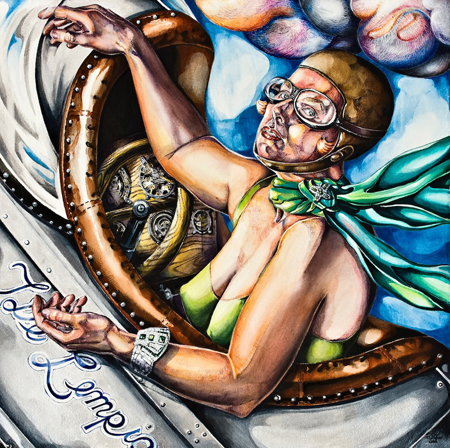
 
Tamara de Lempicka: On Autopilot. Holly Trostle Brigham. 2009.
 
The work, Tamara de Lempicka: On Autopilot, does not depict a woman aviator, but artist, Tamara de Lempicka, who painted celebrities in Europe during the 1920s and 1930s and was well known for her collections of fancy cars and jewelry.  De Lempicka is flying on autopilot, so Brigham could spotlight the spectacular pieces of jewelry that de Lempicka actually owned! Brigham speculates that de Lempicka could have had the opportunity to fly because she was a wealthy woman who was sporty and adventurous. Even if de Lempicka had not ever flown, she sailed beyond what was expected of a woman during her time.
 Flight, to Brigham, is more than piloting a plane or soaring through the clouds wearing a cape. She interprets flight as a metaphor for women aspiring to go beyond stereotypical women’s roles. All of the women Brigham has chosen to depict were determined to succeed in environments that were, for the most part, unreceptive to women. Brigham reminds viewers of the challenges these super women faced and keeps their bravery alive through her works.                                             

Holly Trostle Brigham: Dis/Guise will be on view at the Luther W. Brady Art Gallery  until February 28, 2014.

Taylor Schmidt, Gallery Assistant


Thursday, February 13, 2014

Love is in the Air


Love comes in many forms. It is present within our relationships, our friendships, but also our passions. The life and career of American pilot and World War II commander Nancy Harkness Love illustrates the transformative nature of such passion.
Nancy fell in love very early in life with the idea of flight and her parents encouraged her interests. At thirteen, Nancy left home to study abroad in Europe. While there, Nancy witnessed a true moment in aviation history. Amongst a group of ten thousand, Nancy patiently waited hours on the East side of Le Bourget airfield in Paris. In the sky, a white gray plane flew overhead slowly descending to the ground. The landing lights glared and flooded the field until the plane finally gently rested on the ground in front of Nancy. In that moment, Captain Charles Lindbergh emerged from the plane having just completed his first solo flight across the Atlantic Ocean. Three years later, at the age of sixteen, Nancy was issued a private pilot’s license and began creating her own aviation history.


During her time as a pilot, Nancy established a successful Boston-based aviation company, participated in National air races, and helped ferry an airplane from the United States to France. Most notably, during World War II, Love led all ferrying operations for the Women Airforce Service Pilots (WASP) an aviation organization assembled of female pilots, who were tasked with the responsibility of flying military aircrafts as instructed by the United States Air Forces.[1]


Under her command, female pilots flew almost every type of military aircraft then in the air. Her leadership and passion for flight were instrumental in the success of the organization. For her service, Nancy received an Air Medal award in honor of her meritorious flying and leadership. Before her passing in 1976, Nancy strongly maintained relationships with the women she had commanded and worked with through WASP considering them some of the most important people in her life. These friends and family had been a part of her passion of flight and remained unwavering vestiges of the love she found through her work.

Holly Trostle Brigham, WASP Bea I. Wolf, 2012,

The aviation history that Love created is forefront in Holly Trostle Brigham’s piece WASP Bea I. Wolf featured in Holly Trostle Brigham: Dis/Guise. Brigham’s piece focused on the untold history of the WASPs. Specifically, in the painting, Brigham imagines herself a woman in flight. Painted to resemble a black and white photograph, the piece takes on a historical imagery emphasizing the absent significance and legacy of the organization. In the sixteen months the WASP unit existed, more than 25,000 women applied for training; and of these over a thousand were accepted and successfully completed the program.[2] Yet, upon the disbanding of the program, these women waited over thirty years to receive combat veteran status and eligibility benefits. Thus, Brigham’s piece attempts to honor these women and rectify the neglect of the past. We remember and celebrate their achievements on Nancy Harkness Love's birthday, Valentine's Day, how fitting?  Holly Trostle Brigham: Dis/Guise will be on view at the Luther W. Brady Art Gallery until February 28th.

To learn more about these courageous women pilots and the WASPs you can listen to their story here.

Tuesday, February 11, 2014

A Glimpse into the Mind of Holly Trostle Brigham


Before the opening of Holly Trostle Brighman’s exhibition Holly Trostle Brigham: Dis/ Guise, I had the opportunity to discuss the works in the show with her and delve into her artistic thought process:
The artist in the Luther W. Brady Art Gallery.  Photo: William Atkins
When questioned about which piece from the exhibit Brigham identifies with the most, she immediately turned to Artemesia: Blood for Blood. She commented that the work was a turning point for her. She created the work as a defense for Artemesia Gentileschi during her rape trial and depicts what she imagined the post-rape scene to be from reading the documents detailing the rape and the trial. Brigham includes a pendant, which displays Gentileschi’s work, Susanna and the Elders, which was her first painting completed after the rape.  In the work by Brigham, Gentileschi is shown clutching a lock of her rapist’s hair and a knife that is capped by a figure of Artemis of Ephesus, a symbol of motherhood and fertility. A key with Artemesia’s initials – A.G. inscribed in it, hangs from a ribbon around her neck, showing that she could not have given it to her rapist as he alleged during the trial.
The piece, Hildegard’s Box, is unlike the other works in the exhibit, it is a sculptural work that incorporates Hildegard von Bingen’s songs. The work is a wooden box painted with scenes in oil and features two portraits: Hildegard von Bingen and Dead Hildegard. The door to the box is decorated with a sacred heart and remains ajar, inviting viewers to peek inside. The interior of the box is covered in a lush red fabric and contains two mysterious objects encased in jeweled gold bags. I was eager to discover what the objects were, and during our discussion I was intrigued to hear that it contains two organs – a heart and a tongue – made of wax of course! Brigham expanded on this, explaining Hildegard’s heart and tongue are rumored to be buried beneath the church of Eibingerstrasse in Rüdesheim, Germany.
Two other works in the exhibit are accompanied by relics, which Brigham integrated to provide a more authentic atmosphere. A wedding ring is hung beside the portrait, Henriette DeLille, to reinforce the concept of nuns being married to God. The ring dates back to the early nineteenth century, the time period that the Creole nun lived. Brigham explained that it was common for convents to have a doll to represent baby Jesus, which is why she portrays the figure representative of DeLille holding a doll. The doll, which is depicted as an African-American highlights the nun’s major accomplishment, founding the first African-American religious order – Sisters of the Holy Family. She commented that she felt pity for nuns, because they cared for the doll as if it were a real child, having no children of their own. Santa Caterina’s Trinity, another religious portrait, is complemented by a framed lock of hair. The lock of hair belongs to Brigham, which she decided to use to demonstrate women having to cut their hair to show humility if they wanted to become a nun.   
            During our conversation, Brigham had mentioned her fascination with flight and how she often dreams of flying, which has led to her interest in aviation and her works exploring flight.  Her work, WASP Bea. I. Wolf, was created for a group exhibition that focused on women in World War II, which includes two authentic World War II medals and the badge of the WomenAirforce Service Pilots (WASP). WASP was an organization of civilian women pilots employed to fly military aircrafts in World War II. Bea. I. Wolf., is a play on words that incorporates the bee wolf, a predatory wasp, and Beowulf, a mythical hero, who Brigham links to feminism. The epic poem, thought to be written in 700 A.D., explores the expected gender roles for women. Brigham’s piece shows this woman aviator transcending beyond her traditional roles. The “I” in the title is representative of Isis, an Egyptian goddess of motherhood, nature and magic. Brigham also commented that her choice to use black and white in this portrait was a way to replicate a black and white photograph from the 1940s and then she touched upon her choice of frame for this work, chosen because the frame appears to look like insect wings. She matched most of the frames to the time period of the work she was investigating.

Brigham places herself in the images of female figures of the past in the hope of continuing their message and keeping them alive. She is currently expanding her Seven Sisters II series with other creative images of nuns. She hopes that when she enters the afterlife her works will continue to spread not only her message, but also the messages of the women she has depicted.

About the Blog

Ipsum Tempor

Sit amet

Covering exhibits at the Luther W. Brady Art Gallery and giving you a peek into the Permanent Collection of the George Washington University.

Ultricies Eget

Coming Soon...

Coming Soon...
Howard Hodgkin: Paintings - May 16, 2012
Showing posts with label WASP. Show all posts

Friday, February 21, 2014

Super Women: Holly Trostle Brigham

Imagine you are a super hero, you have one super power, what would you choose? Super human strength? Telekinesis?  Invisibility? Ability to fly would definitely be artist Holly Trostle Brigham’s choice because of her enchantment with flight. Her captivation is communicated through numerous works in Holly Trostle Brigham: Dis/Guise. Flight is depicted literally in the exhibition through the inclusion of winged insects in many of her works, but also portraits of women in aviation. However, to Brigham, flight goes beyond the surface and is interpreted in all of her creations as women transcending beyond their traditional roles.

              Brigham’s earliest work based on flight is Zephyr, Angel, Wings and Me, completed in 2002. The work displays the artist as Amelia Earhart with butterfly wings and holding on to a baby. Zephyr, the Greek god of wind, signifies the baby who is Brigham’s son, Noble. He is portrayed with a human head and the body of a pupa signifying transformation and ones ability to transcend beyond traditional roles. Amelia Earhart is the Angel because of her plane being lost.  Wings is representative of the elements of flight such as the butterfly wings, the airplane and the pupa’s future. She subtly incorporates flight by positioning her hands to resemble the blades of a propeller. Two collaged photographs of Earhart in the background of the work reference a recurring dream that Brigham has of Amelia Earhart landing safely on her final flight. Zephyr, Angel, Wings and Me combines Brigham’s themes of flight, birth, motherhood and transformation, while honoring the achievements of Amelia Earhart.
WASP Bea. I. Wolf. Holly Trostle Brigham. 2012.   
 
In February 2012, Brigham participated in a group exhibition of ten artists, Home Front Heroes: Women of World War II, at Penn State University at Lehigh Valley.  In the early 1940s, during World War II, thousands of women enrolled in courses and sought employment in drafting, chemistry, management, defense training and other skills offered by Penn State Lehigh Valley, filling roles left vacant by men fighting overseas. Brigham contributed her work, WASP Bea. I. Wolf, to the exhibition, which depicts a woman who served in the Women Airforce Service Pilots in the Army Air Corps (WASP). Her work recognizes the many women who bravely served going beyond their established roles in society. 
 
Tamara de Lempicka: On Autopilot. Holly Trostle Brigham. 2009.
 
The work, Tamara de Lempicka: On Autopilot, does not depict a woman aviator, but artist, Tamara de Lempicka, who painted celebrities in Europe during the 1920s and 1930s and was well known for her collections of fancy cars and jewelry.  De Lempicka is flying on autopilot, so Brigham could spotlight the spectacular pieces of jewelry that de Lempicka actually owned! Brigham speculates that de Lempicka could have had the opportunity to fly because she was a wealthy woman who was sporty and adventurous. Even if de Lempicka had not ever flown, she sailed beyond what was expected of a woman during her time.
 Flight, to Brigham, is more than piloting a plane or soaring through the clouds wearing a cape. She interprets flight as a metaphor for women aspiring to go beyond stereotypical women’s roles. All of the women Brigham has chosen to depict were determined to succeed in environments that were, for the most part, unreceptive to women. Brigham reminds viewers of the challenges these super women faced and keeps their bravery alive through her works.                                             

Holly Trostle Brigham: Dis/Guise will be on view at the Luther W. Brady Art Gallery  until February 28, 2014.

Taylor Schmidt, Gallery Assistant


Thursday, February 13, 2014

Love is in the Air


Love comes in many forms. It is present within our relationships, our friendships, but also our passions. The life and career of American pilot and World War II commander Nancy Harkness Love illustrates the transformative nature of such passion.
Nancy fell in love very early in life with the idea of flight and her parents encouraged her interests. At thirteen, Nancy left home to study abroad in Europe. While there, Nancy witnessed a true moment in aviation history. Amongst a group of ten thousand, Nancy patiently waited hours on the East side of Le Bourget airfield in Paris. In the sky, a white gray plane flew overhead slowly descending to the ground. The landing lights glared and flooded the field until the plane finally gently rested on the ground in front of Nancy. In that moment, Captain Charles Lindbergh emerged from the plane having just completed his first solo flight across the Atlantic Ocean. Three years later, at the age of sixteen, Nancy was issued a private pilot’s license and began creating her own aviation history.


During her time as a pilot, Nancy established a successful Boston-based aviation company, participated in National air races, and helped ferry an airplane from the United States to France. Most notably, during World War II, Love led all ferrying operations for the Women Airforce Service Pilots (WASP) an aviation organization assembled of female pilots, who were tasked with the responsibility of flying military aircrafts as instructed by the United States Air Forces.[1]


Under her command, female pilots flew almost every type of military aircraft then in the air. Her leadership and passion for flight were instrumental in the success of the organization. For her service, Nancy received an Air Medal award in honor of her meritorious flying and leadership. Before her passing in 1976, Nancy strongly maintained relationships with the women she had commanded and worked with through WASP considering them some of the most important people in her life. These friends and family had been a part of her passion of flight and remained unwavering vestiges of the love she found through her work.

Holly Trostle Brigham, WASP Bea I. Wolf, 2012,

The aviation history that Love created is forefront in Holly Trostle Brigham’s piece WASP Bea I. Wolf featured in Holly Trostle Brigham: Dis/Guise. Brigham’s piece focused on the untold history of the WASPs. Specifically, in the painting, Brigham imagines herself a woman in flight. Painted to resemble a black and white photograph, the piece takes on a historical imagery emphasizing the absent significance and legacy of the organization. In the sixteen months the WASP unit existed, more than 25,000 women applied for training; and of these over a thousand were accepted and successfully completed the program.[2] Yet, upon the disbanding of the program, these women waited over thirty years to receive combat veteran status and eligibility benefits. Thus, Brigham’s piece attempts to honor these women and rectify the neglect of the past. We remember and celebrate their achievements on Nancy Harkness Love's birthday, Valentine's Day, how fitting?  Holly Trostle Brigham: Dis/Guise will be on view at the Luther W. Brady Art Gallery until February 28th.

To learn more about these courageous women pilots and the WASPs you can listen to their story here.

Tuesday, February 11, 2014

A Glimpse into the Mind of Holly Trostle Brigham


Before the opening of Holly Trostle Brighman’s exhibition Holly Trostle Brigham: Dis/ Guise, I had the opportunity to discuss the works in the show with her and delve into her artistic thought process:
The artist in the Luther W. Brady Art Gallery.  Photo: William Atkins
When questioned about which piece from the exhibit Brigham identifies with the most, she immediately turned to Artemesia: Blood for Blood. She commented that the work was a turning point for her. She created the work as a defense for Artemesia Gentileschi during her rape trial and depicts what she imagined the post-rape scene to be from reading the documents detailing the rape and the trial. Brigham includes a pendant, which displays Gentileschi’s work, Susanna and the Elders, which was her first painting completed after the rape.  In the work by Brigham, Gentileschi is shown clutching a lock of her rapist’s hair and a knife that is capped by a figure of Artemis of Ephesus, a symbol of motherhood and fertility. A key with Artemesia’s initials – A.G. inscribed in it, hangs from a ribbon around her neck, showing that she could not have given it to her rapist as he alleged during the trial.
The piece, Hildegard’s Box, is unlike the other works in the exhibit, it is a sculptural work that incorporates Hildegard von Bingen’s songs. The work is a wooden box painted with scenes in oil and features two portraits: Hildegard von Bingen and Dead Hildegard. The door to the box is decorated with a sacred heart and remains ajar, inviting viewers to peek inside. The interior of the box is covered in a lush red fabric and contains two mysterious objects encased in jeweled gold bags. I was eager to discover what the objects were, and during our discussion I was intrigued to hear that it contains two organs – a heart and a tongue – made of wax of course! Brigham expanded on this, explaining Hildegard’s heart and tongue are rumored to be buried beneath the church of Eibingerstrasse in Rüdesheim, Germany.
Two other works in the exhibit are accompanied by relics, which Brigham integrated to provide a more authentic atmosphere. A wedding ring is hung beside the portrait, Henriette DeLille, to reinforce the concept of nuns being married to God. The ring dates back to the early nineteenth century, the time period that the Creole nun lived. Brigham explained that it was common for convents to have a doll to represent baby Jesus, which is why she portrays the figure representative of DeLille holding a doll. The doll, which is depicted as an African-American highlights the nun’s major accomplishment, founding the first African-American religious order – Sisters of the Holy Family. She commented that she felt pity for nuns, because they cared for the doll as if it were a real child, having no children of their own. Santa Caterina’s Trinity, another religious portrait, is complemented by a framed lock of hair. The lock of hair belongs to Brigham, which she decided to use to demonstrate women having to cut their hair to show humility if they wanted to become a nun.   
            During our conversation, Brigham had mentioned her fascination with flight and how she often dreams of flying, which has led to her interest in aviation and her works exploring flight.  Her work, WASP Bea. I. Wolf, was created for a group exhibition that focused on women in World War II, which includes two authentic World War II medals and the badge of the WomenAirforce Service Pilots (WASP). WASP was an organization of civilian women pilots employed to fly military aircrafts in World War II. Bea. I. Wolf., is a play on words that incorporates the bee wolf, a predatory wasp, and Beowulf, a mythical hero, who Brigham links to feminism. The epic poem, thought to be written in 700 A.D., explores the expected gender roles for women. Brigham’s piece shows this woman aviator transcending beyond her traditional roles. The “I” in the title is representative of Isis, an Egyptian goddess of motherhood, nature and magic. Brigham also commented that her choice to use black and white in this portrait was a way to replicate a black and white photograph from the 1940s and then she touched upon her choice of frame for this work, chosen because the frame appears to look like insect wings. She matched most of the frames to the time period of the work she was investigating.

Brigham places herself in the images of female figures of the past in the hope of continuing their message and keeping them alive. She is currently expanding her Seven Sisters II series with other creative images of nuns. She hopes that when she enters the afterlife her works will continue to spread not only her message, but also the messages of the women she has depicted.

Labels

Lorem ipsum

.

Lorem ipsum

Recent News

About

Washington, District of Columbia, United States
"Found In Collection" or simply "FIC" is the way many museums classify the more mysterious items in their possession that have little or no documentation. Here at the Luther W. Brady Art Gallery of the George Washington University, we do keep extensive records of our collection, but some of the items we come across in academic buildings or our own storage can leave us wondering. This blog is an effort to showcase some of the more curious examples and their stories, and to provide a glimpse of the great variety of art pieces within the collection. To learn more about the Brady Gallery's history, recent exhibitions, or the George Washington University, take a look at the links below.

Followers