Showing posts with label Philadelphia. Show all posts

Friday, March 31, 2017

Margaretta Peale

James Peale, Anna and Margaretta Peale, ca. 1805. 
Oil on canvas, 29 x 24 in. Pennsylvania Academy 
Margaretta Peale (1785-1882) comes from a prominent family of painters. Her uncle, Charles Willson Peale (1741-1827), is probably the most famous in the Peale family. Charles Willson Peale is known for his portraiture of prominent figures, and also establishing the Philadelphia Museum, one of the first museums in America. Some of Charles Willson Peale’s sons (Margaretta’s cousins) continued in the family business of painting. They are notable for their still lifes and portraits, as well as their unusual names - Rembrandt, Raphaelle, and Titian - names of some of Charles Willson Peale’s favorite artists. [1]


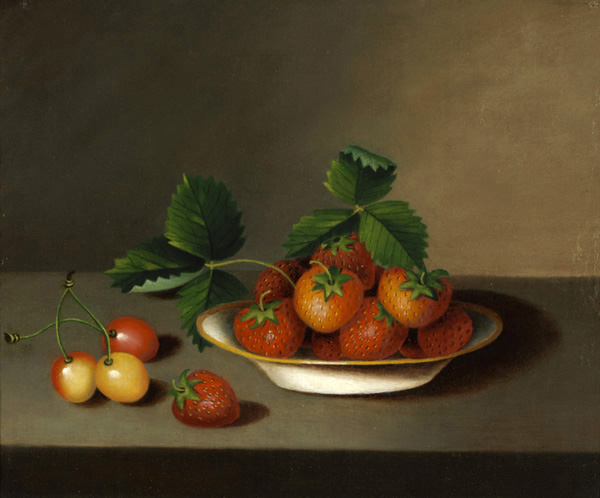
Margaretta Peale, Strawberries and
Cherries, n.d. Oil on canvas, 10-1/16 
x 12-1/8 in. Pennsylvania Academy
Margaretta’s father, James Peale (1749-1831), was the younger brother of Charles Willson Peale. He was taught how to paint by his older brother and also worked in his studio. James Peale is most notable for his still lifes and miniature paintings. [2] He had six children, most famously Margaretta and her sisters Anna Claypoole Peale (1791-1878) and Sarah Miriam Peale (1800-1885). Margaretta’s sisters were acclaimed female painters of their time and became the first women members of the Pennsylvania Academy of the Fine Arts (PAFA), which was the first arts academy in America. They were also among the first women to professionally paint for a living. [3] While Margaretta was not a member of PAFA, she still had the honor of exhibiting her work at the academy. Today Margaretta’s legacy is still overshadowed by that of her sisters, however this is most likely due to the fact that many of her paintings no longer exist.

Margaretta Peale, William Staughton, D.D., n.d.
Oil on canvas. The George Washington University
Permanent Collection.
Although Margaretta Peale was most known for her still life paintings, George Washington University owns five of her portrait paintings - possibly the only ones that are still in existence. The portraits are of William Staughton, Stephen Chapin, William Ruggles and Joseph Getchell Binney (the fifth portrait is an unidentified sitter). These four men all were presidents of the Columbian College, known today as George Washington University.

William Staughton was the first president of the college from 1821-1827. Margaretta was commissioned in 1866 to paint this portrait from her cousin Rembrandt’s portrait of Staughton (Staughton’s portrait by Margaretta is currently in the General Counsel’s office). Staughton had close ties with the Peale family presumably because he knew the Peale family while he lived in Philadelphia as a Baptist Minister, and later he became Margaretta’s brother-in-law. Anna Claypoole Peale was the second wife of Staughton and married him in August 1829, unfortunately that same year he died. [4] A portrait of William Staughton painted by James Peale in 1811 is also owned by GWU and can be found next to Margaretta’s portrait of Stephen Chapin in a small gallery in Gelman Library on the first floor.

Margaretta Peale, Stephen Chapin, D.D., c.1868. 
Oil on canvas. The George Washington 
University Permanent Collection.

Stephen Chapin was the second President of the Columbian College from 1828-1841. This portrait, painted around 1868, was commissioned by the Board of Trustees for the University. The board asked Margaretta to paint the portrait of Dr. Chapin from a likeness of his portrait owned by William Ruggles.

William Ruggles was never officially a president of the University, but served as an acting president three times from 1822-1877 during his years as a GWU faculty member. [5] Ruggles was a very influential person at the University, and holds the record of the longest consecutive period of teaching at GWU. Ruggles's portrait is currently in the Lenthall Townhouses.

Margaretta Peale, William Ruggles, n.d. Oil on 
canvas. The George Washington University 
PermanentCollection.

Margaretta Peale, Joseph Getchell Binney, D.D.
(Doctor of Divinity), n.d. Oil on canvas. The George
Washington University Permanent Collection.
Margaretta Peale, Unidentified sitter, ca. 1868. 
Oil on canvas. The George Washington University
Permanent Collection.


Joseph Getchell Binney was the fourth President of GWU from 1855-1858, and his portrait can be found in the the School of Media and Public Affairs at the George Washington University. His portrait was recently on view in our exhibition The Other 90%.

By Maria Gorbaty, Gallery Assistant

To learn more about the Luther W. Brady Art Gallery and the George Washington University’s Permanent Collection, please
visit our website.
_________________________________
[1] http://philadelphiaencyclopedia.org/
[2] http://americanart.si.edu/
[3] https://nmwa.org
[4] https://library.gwu.edu/ead/ms0311.xml
[5] http://library.gwu.edu/ead/rg0002.xml#ref1109

Monday, May 16, 2016

The Other 90%: Alice Neel

We’re spotlighting some of the artists included in The Other 90%: Works from the GW Permanent Collection, on view now through June 3, 2016 at the Luther W. Brady Art Gallery.


Life & Career


Alice Neel (1900-1984) was one of the most prolific American portrait painters of the twentieth century. Although abstraction was popular during the 1940s and 50s, she continued to paint in a style that depicted real people from celebrities of the art world like Andy Warhol to impoverish Neighbors in Spanish Harlem. Her gift was being able to reveal something of her sitters’ inner selves through depictions of their outer appearance.[1]

Neel was born in Merion Square, Pennsylvania and began her art education at the Philadelphia School of Design for Women (now known as Moore College of Art and Design), enrolled from 1921-25 Her early life was turbulent and her marriage to the artist Carlos Enriquez took her from Pennsylvania to Cuba to New York. With the death of a child and a disintegrating marriage, she suffered from anxiety and depression, which led to several suicide attempts. By 1932 she had returned to painting and to New York, where she participated in the First Washington Square Outdoor Art Exhibit that year. Like many artists living in New York during the 1930s, Neel joined the Public Works of Art Project (which would later become the Works Progress Administration, WPA), a government-funded program run under the Whitney Museum of American Art; she worked with the program on and off again until its termination in 1943.[2]

While she was included in a number group shows and small exhibitions during the 1940s and 50s, Neel only began to see increased recognition in the 1960s. By 1974 the Whitney Museum of American Art was holding a retrospective of her work, which many considered to be ‘too little, too late’ although she considered it a triumph. In 1984, the year of her death, she appeared twice on “The Tonight Show” with Johnny Carson, offering to paint his portrait.[3]


Activism


Neel was an activist throughout her life. She was investigated in 1955 by the FBI who had been looking into her activities with the Communist Party since 1951. Their file described her as a “romantic Bohemian type communist.” [4] In 1959, she appeared in the Beat film Pull My Daisy with Jack Kerouac, Allen Ginsberg and Peter Orlovsky, among others. In 1968 she participated in a protest of the Whitney Museum of American Art over the exhibition 1930s Painting and Sculpture in America, because of its lack of women and African American artists, and again over the exhibition, Contemporary Black Artists in America, which was accused of being hastily organized by its curator, Robert Doty. 

She participated in a demonstration against the Metropolitan Museum of Art’s exhibition, Harlem on My Mind, in 1969; she, Raphael Soyer, John Dobbs, and Mel Roman were the only white artists to attend the demonstration, organized by the Black Emergency Cultural Coalition. She also stood with the Black Emergency Cultural Coalition and Artists and Writers Protest Against the War in Vietnam opposing Governor Nelson rockefeller's handling of the Attica prison riot in 1971. Her portrait of Kate Millet appeared on the cover of Time magazine in 1970 in an issue dedicated to the “Politics of Sex.” Between 1973 and 1975 she participated in at least eight exhibitions exclusively devoted to the work of women artists.


Connections


As a major figure in the art world during the last decades of her life, she had connections to a number of other artists exhibited in The Other 90 Percent. In 1970 she painted a portrait of Andy Warhol, and Warhol attended and photographed a dinner held in honor of Neel by NYC Mayor Ed Koch at Gracie Mansion in 1982. [5] She protested with Raphael Soyer, and also painted a portrait of the artist and his twin brother, the artist Moses Soyer, in 1973. In 1972 she participated in the “Conference of Women in the Visual Arts,” held at the Corcoran School of Art, in Washington, D.C., taking the opportunity to present slides of her work.

Alice Neel, Family, 1982, lithograph, ed. 68/175, 
31-1/4 x 27 inches. The George Washington 
University Permanent Collection. Gift of James 
M. Kearns, 1993. 


Artistic Style


Although, she had numerous illustrations printed in the magazine Masses and Mainstream during the forties and fifties, Neel did not begin making prints, like the one shown here, until later in her career. She worked with Judith Solodkin at Rutgers University in 1977 to produce Nancy, a lithograph, and an etching, Young Man. [6] The lithograph in the GW Permanent Collection, Family (1982), is representative of her style of portraiture: strong outlines, bold brushstrokes, and tilted perspectives create a flatness against the picture plane and often suggests the uneasiness and personal struggles of many of her sitters.


[1] National Museum of Women in the Arts, “Alice Neel, 1900-1984,” <http://nmwa.org/explore/artist-profiles/alice-neel> Accessed 14 March, 2016.
[2] Sarah Powers, “Chronology,” in Alice Neel, exhibition catalog, June 29, 2000–December 30, 2001, Philadelphia Museum of Art and four other institutions, 159-176.
[3] Powers, 176.
[4] Powers, 169.
[5] Powers, 175.
[6] Powers, 174.

About the Blog

Ipsum Tempor

Sit amet

Covering exhibits at the Luther W. Brady Art Gallery and giving you a peek into the Permanent Collection of the George Washington University.

Ultricies Eget

Coming Soon...

Coming Soon...
Howard Hodgkin: Paintings - May 16, 2012
Showing posts with label Philadelphia. Show all posts

Friday, March 31, 2017

Margaretta Peale

James Peale, Anna and Margaretta Peale, ca. 1805. 
Oil on canvas, 29 x 24 in. Pennsylvania Academy 
Margaretta Peale (1785-1882) comes from a prominent family of painters. Her uncle, Charles Willson Peale (1741-1827), is probably the most famous in the Peale family. Charles Willson Peale is known for his portraiture of prominent figures, and also establishing the Philadelphia Museum, one of the first museums in America. Some of Charles Willson Peale’s sons (Margaretta’s cousins) continued in the family business of painting. They are notable for their still lifes and portraits, as well as their unusual names - Rembrandt, Raphaelle, and Titian - names of some of Charles Willson Peale’s favorite artists. [1]


Margaretta Peale, Strawberries and
Cherries, n.d. Oil on canvas, 10-1/16 
x 12-1/8 in. Pennsylvania Academy
Margaretta’s father, James Peale (1749-1831), was the younger brother of Charles Willson Peale. He was taught how to paint by his older brother and also worked in his studio. James Peale is most notable for his still lifes and miniature paintings. [2] He had six children, most famously Margaretta and her sisters Anna Claypoole Peale (1791-1878) and Sarah Miriam Peale (1800-1885). Margaretta’s sisters were acclaimed female painters of their time and became the first women members of the Pennsylvania Academy of the Fine Arts (PAFA), which was the first arts academy in America. They were also among the first women to professionally paint for a living. [3] While Margaretta was not a member of PAFA, she still had the honor of exhibiting her work at the academy. Today Margaretta’s legacy is still overshadowed by that of her sisters, however this is most likely due to the fact that many of her paintings no longer exist.

Margaretta Peale, William Staughton, D.D., n.d.
Oil on canvas. The George Washington University
Permanent Collection.
Although Margaretta Peale was most known for her still life paintings, George Washington University owns five of her portrait paintings - possibly the only ones that are still in existence. The portraits are of William Staughton, Stephen Chapin, William Ruggles and Joseph Getchell Binney (the fifth portrait is an unidentified sitter). These four men all were presidents of the Columbian College, known today as George Washington University.

William Staughton was the first president of the college from 1821-1827. Margaretta was commissioned in 1866 to paint this portrait from her cousin Rembrandt’s portrait of Staughton (Staughton’s portrait by Margaretta is currently in the General Counsel’s office). Staughton had close ties with the Peale family presumably because he knew the Peale family while he lived in Philadelphia as a Baptist Minister, and later he became Margaretta’s brother-in-law. Anna Claypoole Peale was the second wife of Staughton and married him in August 1829, unfortunately that same year he died. [4] A portrait of William Staughton painted by James Peale in 1811 is also owned by GWU and can be found next to Margaretta’s portrait of Stephen Chapin in a small gallery in Gelman Library on the first floor.

Margaretta Peale, Stephen Chapin, D.D., c.1868. 
Oil on canvas. The George Washington 
University Permanent Collection.

Stephen Chapin was the second President of the Columbian College from 1828-1841. This portrait, painted around 1868, was commissioned by the Board of Trustees for the University. The board asked Margaretta to paint the portrait of Dr. Chapin from a likeness of his portrait owned by William Ruggles.

William Ruggles was never officially a president of the University, but served as an acting president three times from 1822-1877 during his years as a GWU faculty member. [5] Ruggles was a very influential person at the University, and holds the record of the longest consecutive period of teaching at GWU. Ruggles's portrait is currently in the Lenthall Townhouses.

Margaretta Peale, William Ruggles, n.d. Oil on 
canvas. The George Washington University 
PermanentCollection.

Margaretta Peale, Joseph Getchell Binney, D.D.
(Doctor of Divinity), n.d. Oil on canvas. The George
Washington University Permanent Collection.
Margaretta Peale, Unidentified sitter, ca. 1868. 
Oil on canvas. The George Washington University
Permanent Collection.


Joseph Getchell Binney was the fourth President of GWU from 1855-1858, and his portrait can be found in the the School of Media and Public Affairs at the George Washington University. His portrait was recently on view in our exhibition The Other 90%.

By Maria Gorbaty, Gallery Assistant

To learn more about the Luther W. Brady Art Gallery and the George Washington University’s Permanent Collection, please
visit our website.
_________________________________
[1] http://philadelphiaencyclopedia.org/
[2] http://americanart.si.edu/
[3] https://nmwa.org
[4] https://library.gwu.edu/ead/ms0311.xml
[5] http://library.gwu.edu/ead/rg0002.xml#ref1109

Monday, May 16, 2016

The Other 90%: Alice Neel

We’re spotlighting some of the artists included in The Other 90%: Works from the GW Permanent Collection, on view now through June 3, 2016 at the Luther W. Brady Art Gallery.


Life & Career


Alice Neel (1900-1984) was one of the most prolific American portrait painters of the twentieth century. Although abstraction was popular during the 1940s and 50s, she continued to paint in a style that depicted real people from celebrities of the art world like Andy Warhol to impoverish Neighbors in Spanish Harlem. Her gift was being able to reveal something of her sitters’ inner selves through depictions of their outer appearance.[1]

Neel was born in Merion Square, Pennsylvania and began her art education at the Philadelphia School of Design for Women (now known as Moore College of Art and Design), enrolled from 1921-25 Her early life was turbulent and her marriage to the artist Carlos Enriquez took her from Pennsylvania to Cuba to New York. With the death of a child and a disintegrating marriage, she suffered from anxiety and depression, which led to several suicide attempts. By 1932 she had returned to painting and to New York, where she participated in the First Washington Square Outdoor Art Exhibit that year. Like many artists living in New York during the 1930s, Neel joined the Public Works of Art Project (which would later become the Works Progress Administration, WPA), a government-funded program run under the Whitney Museum of American Art; she worked with the program on and off again until its termination in 1943.[2]

While she was included in a number group shows and small exhibitions during the 1940s and 50s, Neel only began to see increased recognition in the 1960s. By 1974 the Whitney Museum of American Art was holding a retrospective of her work, which many considered to be ‘too little, too late’ although she considered it a triumph. In 1984, the year of her death, she appeared twice on “The Tonight Show” with Johnny Carson, offering to paint his portrait.[3]


Activism


Neel was an activist throughout her life. She was investigated in 1955 by the FBI who had been looking into her activities with the Communist Party since 1951. Their file described her as a “romantic Bohemian type communist.” [4] In 1959, she appeared in the Beat film Pull My Daisy with Jack Kerouac, Allen Ginsberg and Peter Orlovsky, among others. In 1968 she participated in a protest of the Whitney Museum of American Art over the exhibition 1930s Painting and Sculpture in America, because of its lack of women and African American artists, and again over the exhibition, Contemporary Black Artists in America, which was accused of being hastily organized by its curator, Robert Doty. 

She participated in a demonstration against the Metropolitan Museum of Art’s exhibition, Harlem on My Mind, in 1969; she, Raphael Soyer, John Dobbs, and Mel Roman were the only white artists to attend the demonstration, organized by the Black Emergency Cultural Coalition. She also stood with the Black Emergency Cultural Coalition and Artists and Writers Protest Against the War in Vietnam opposing Governor Nelson rockefeller's handling of the Attica prison riot in 1971. Her portrait of Kate Millet appeared on the cover of Time magazine in 1970 in an issue dedicated to the “Politics of Sex.” Between 1973 and 1975 she participated in at least eight exhibitions exclusively devoted to the work of women artists.


Connections


As a major figure in the art world during the last decades of her life, she had connections to a number of other artists exhibited in The Other 90 Percent. In 1970 she painted a portrait of Andy Warhol, and Warhol attended and photographed a dinner held in honor of Neel by NYC Mayor Ed Koch at Gracie Mansion in 1982. [5] She protested with Raphael Soyer, and also painted a portrait of the artist and his twin brother, the artist Moses Soyer, in 1973. In 1972 she participated in the “Conference of Women in the Visual Arts,” held at the Corcoran School of Art, in Washington, D.C., taking the opportunity to present slides of her work.

Alice Neel, Family, 1982, lithograph, ed. 68/175, 
31-1/4 x 27 inches. The George Washington 
University Permanent Collection. Gift of James 
M. Kearns, 1993. 


Artistic Style


Although, she had numerous illustrations printed in the magazine Masses and Mainstream during the forties and fifties, Neel did not begin making prints, like the one shown here, until later in her career. She worked with Judith Solodkin at Rutgers University in 1977 to produce Nancy, a lithograph, and an etching, Young Man. [6] The lithograph in the GW Permanent Collection, Family (1982), is representative of her style of portraiture: strong outlines, bold brushstrokes, and tilted perspectives create a flatness against the picture plane and often suggests the uneasiness and personal struggles of many of her sitters.


[1] National Museum of Women in the Arts, “Alice Neel, 1900-1984,” <http://nmwa.org/explore/artist-profiles/alice-neel> Accessed 14 March, 2016.
[2] Sarah Powers, “Chronology,” in Alice Neel, exhibition catalog, June 29, 2000–December 30, 2001, Philadelphia Museum of Art and four other institutions, 159-176.
[3] Powers, 176.
[4] Powers, 169.
[5] Powers, 175.
[6] Powers, 174.

Labels

Lorem ipsum

.

Lorem ipsum

Recent News

About

Washington, District of Columbia, United States
"Found In Collection" or simply "FIC" is the way many museums classify the more mysterious items in their possession that have little or no documentation. Here at the Luther W. Brady Art Gallery of the George Washington University, we do keep extensive records of our collection, but some of the items we come across in academic buildings or our own storage can leave us wondering. This blog is an effort to showcase some of the more curious examples and their stories, and to provide a glimpse of the great variety of art pieces within the collection. To learn more about the Brady Gallery's history, recent exhibitions, or the George Washington University, take a look at the links below.

Followers